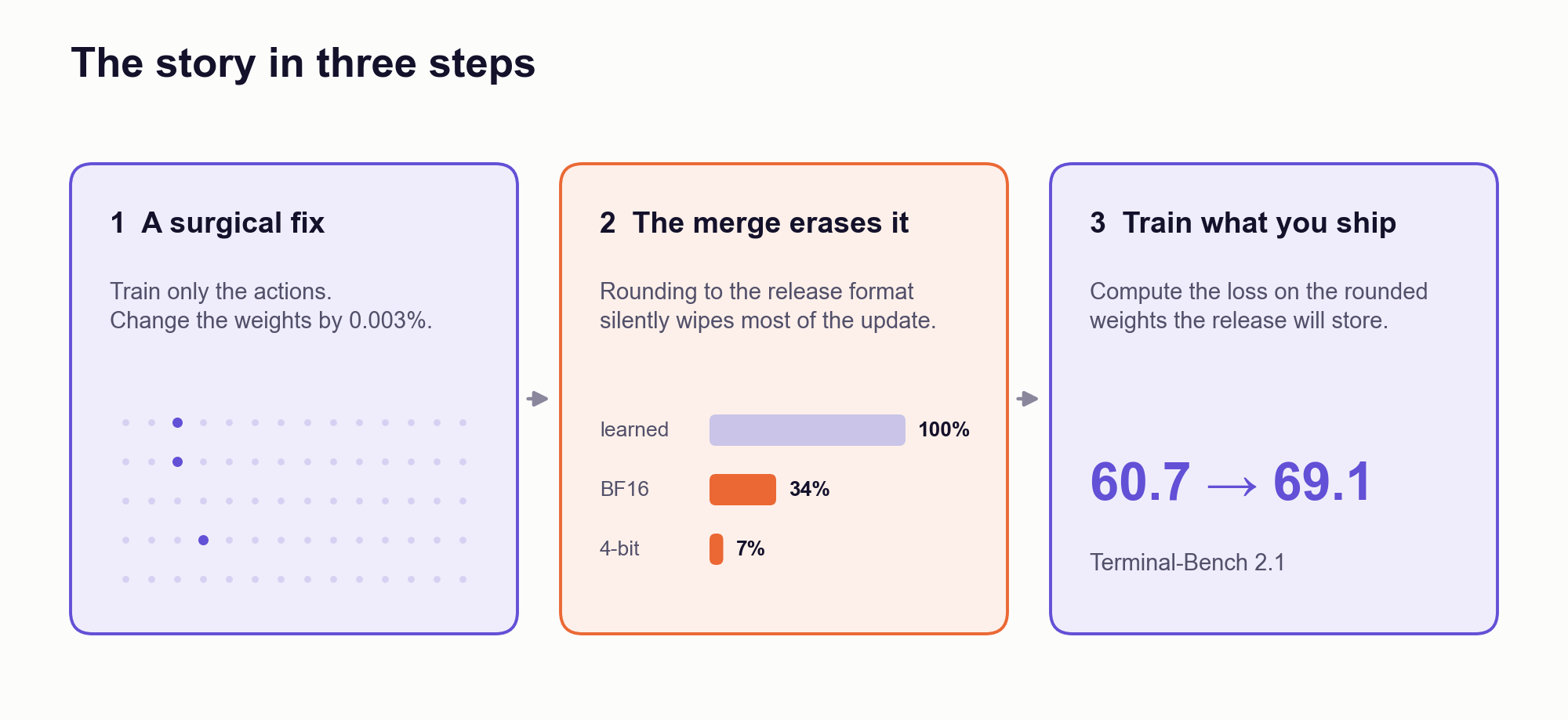
Your model reasons fine. It fails on small missteps: retrying a command that already failed, calling a task done too early. We fixed that in a 120B model with a weight change of just 0.003%, and Terminal-Bench 2.1 went from 60.7 to 69.1.
The hard part wasn't the fix. It was making it survive the release.
This is the story behind our new paper, Fix How It Acts, Not How It Thinks, and the two open models it produced.
Paper: arXiv:2611.32064 · Models on Hugging Face: Smaug-Nemotron-3.5 (BF16) · Smaug-Nemotron-3.5-NVFP4
Acts, not thinks
Watch a strong open model work through a long coding task and you'll see it reason well, then trip over its own actions. It re-runs a command that already failed. It declares victory while a requirement is still unmet. Over dozens of turns, a few slips like these decide pass or fail.
So we didn't want to change how the model thinks. We wanted to change how it acts, and touch nothing else. That called for a surgical update:
Train only the actions. In our agentic coding trajectories, fewer than 6% of tokens are actions: the tool calls and the moments the model ends its turn. Only those get a training signal. The model's reasoning is held close to where it started.
Keep the change tiny. In our runs, checkpoints that drifted further from the base scored worse. The released model's weights move by just 0.003%.
The training trajectories teach three habits: explore before acting, verify before submitting, and finish cleanly. Then we hit a wall that nobody warns you about.
The fix that vanished
LoRA learns a small update that sits next to the frozen weights. To ship it, you merge the update into the model and save the result in the release's number format: BF16, or FP8 and 4-bit NVFP4 for the cheaper quantized release. Saving means rounding every weight onto that format's grid.
A surgical update is far smaller than one grid step. In our BF16 release, the median weight change was 1.5% of a single rounding step, so almost every weight rounded straight back to where it started. Here is how much of our adapter's update survives the merge:
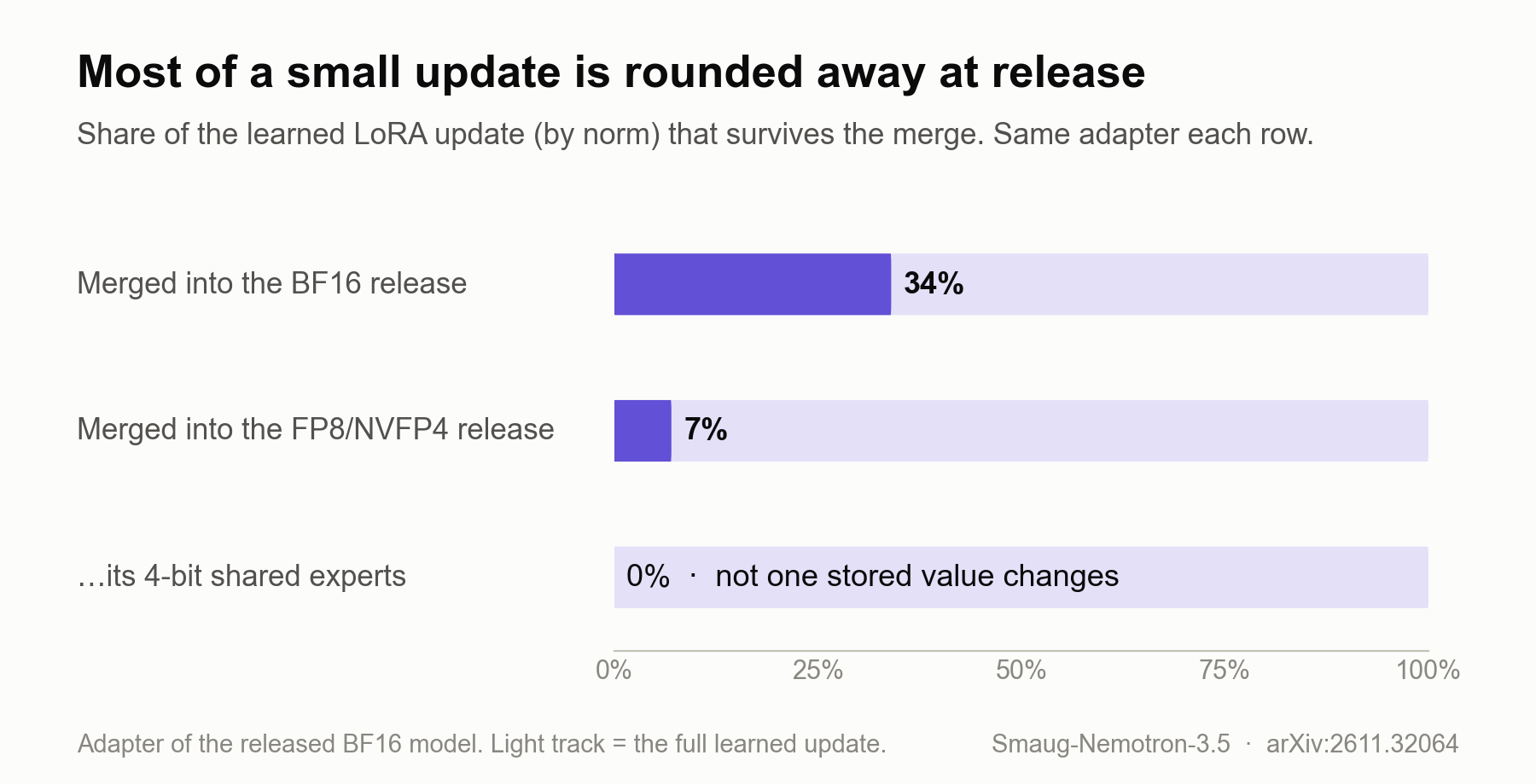
Only 34% survives in BF16. In the 4-bit release, just 7% does, and the 4-bit shared experts don't change a single stored value. What survives even points in a different direction from what the model learned.
The worst part is that nothing tells you. The merge succeeds, the model loads, and it serves. The behavior you trained is simply gone, and you only find out from the benchmarks.
A bigger update would survive better, but then it isn't surgical anymore. We went the other way.
Train the model you ship
Standard LoRA trains in full precision and rounds once, at export, so the loss never sees the model people actually download. Merge-aware fine-tuning flips that. At every training step, we build the exact rounded weights the release will contain, W′ = Q(W + sBA), using the vendor's own quantization scales, and compute the loss on them.
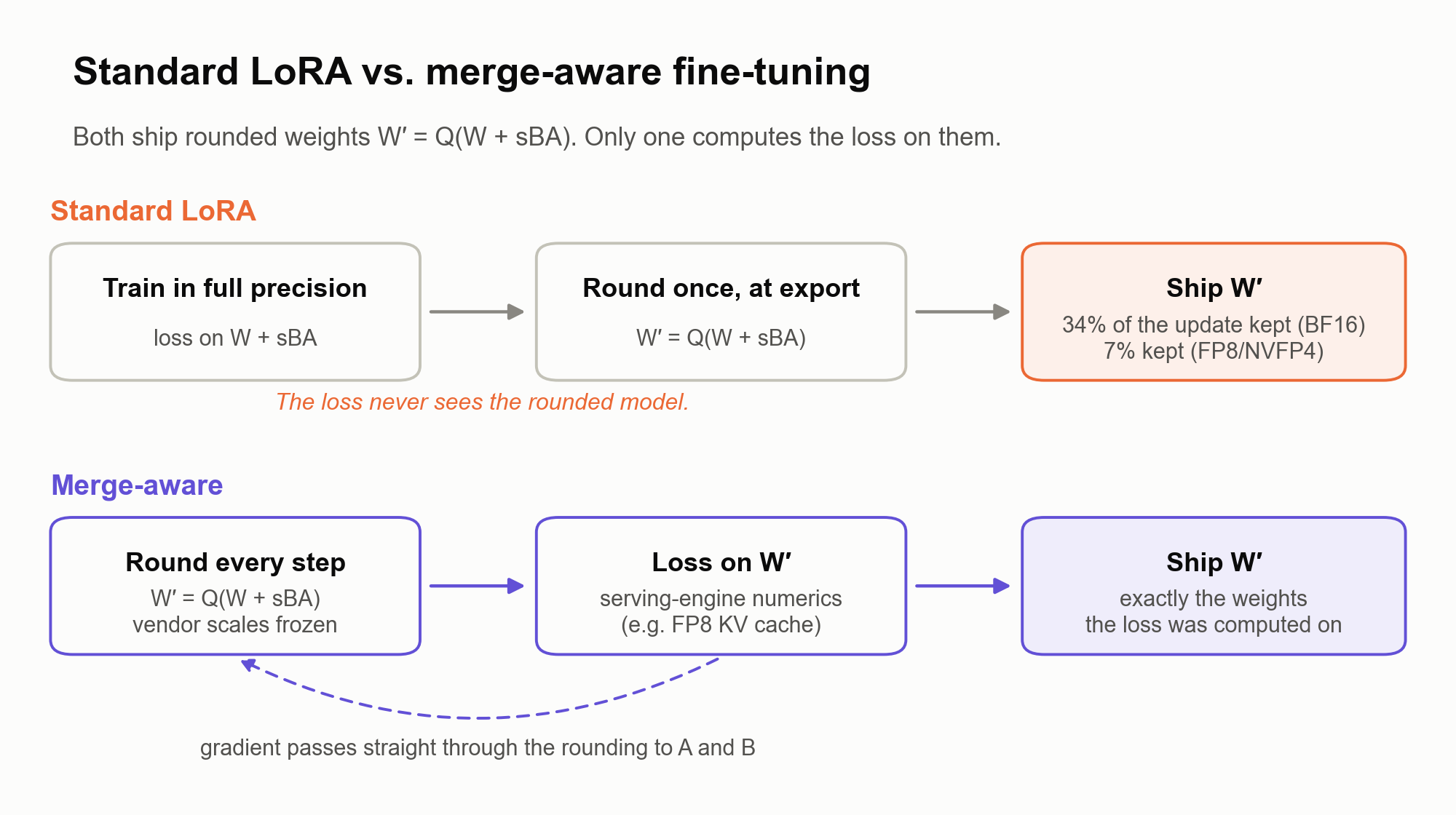
Mathematically, the whole method comes down to two decisions:
Forward: the loss sees the shipped weights. Every adapted layer computes h = x·W′ᵀ with W′ = Q(W + sBA), bit for bit what the serving engine will run.
Backward: the gradient skips the rounding. We treat ∂W′/∂(sBA) as the identity, so A and B receive the ordinary LoRA gradient, computed through the served network.
Why the second decision? Rounding is a staircase, and its slope is zero almost everywhere. An honest gradient through it would never move anything. The straight-through gradient treats the staircase as a ramp on the way back, while the forward pass keeps the real steps. Underneath, the adapter keeps learning in full precision, and a served weight jumps to the next grid value only when its accumulated change crosses a rounding boundary. From that moment on, the loss sees it:
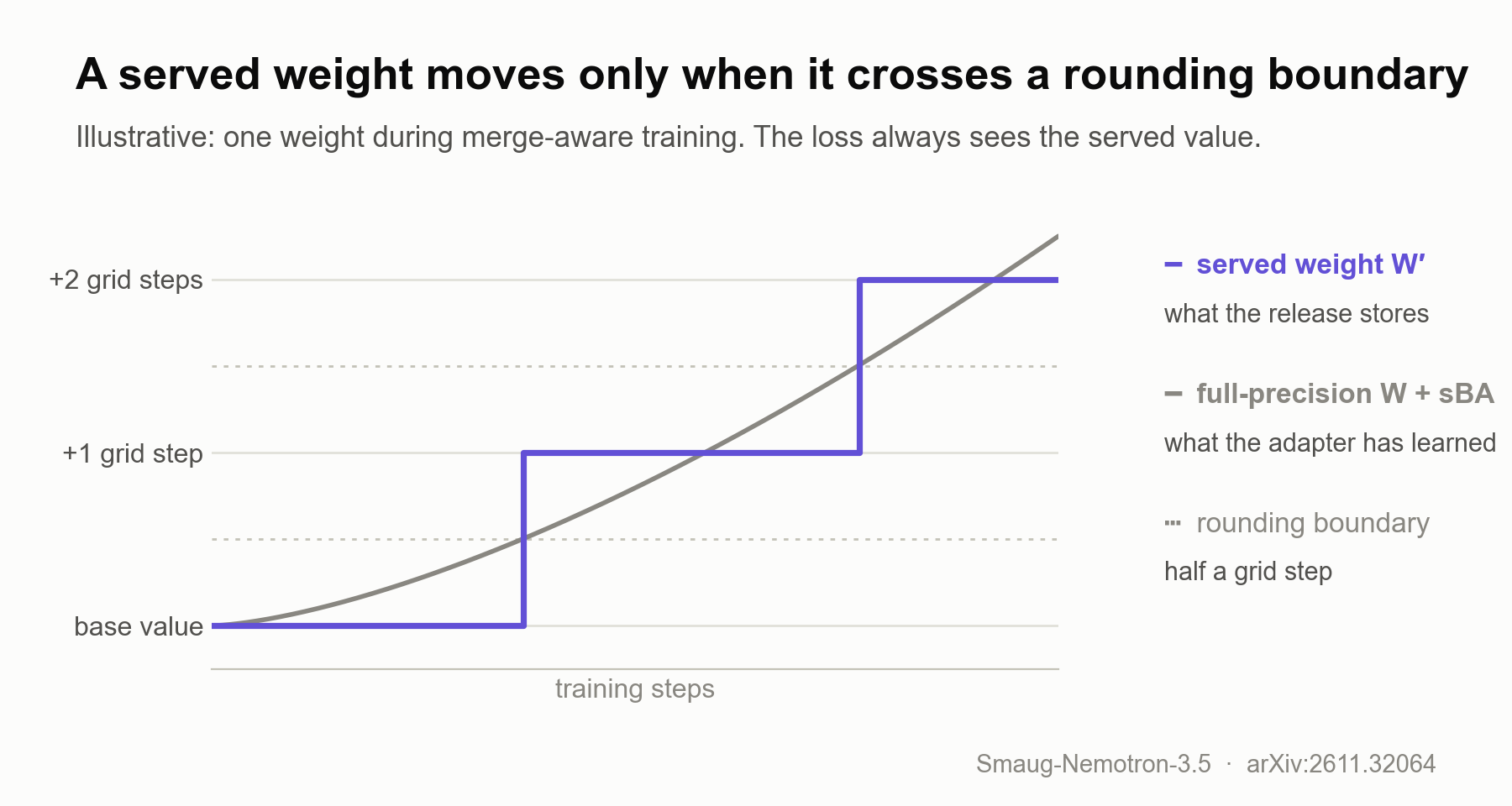
Merge-aware training doesn't keep more of the update. It makes the part that survives the part that does the work.
Two more details turned out to matter at 120B scale:
Match the serving engine, not just the weights. vLLM stores attention keys and values in FP8, and the training library doesn't. In early runs on a smaller model, ignoring that one difference cost more than half of the gain once served.
Give coarse formats bigger steps. FP8 weights train at 4× the learning rate so they move as far as BF16 weights. The 4-bit experts would need about 100×, so we leave them frozen and adapt other layers instead.
Every checkpoint we ship holds exactly the weights the loss saw. Outside the adapted layers, it is byte-identical to NVIDIA's release.
Results
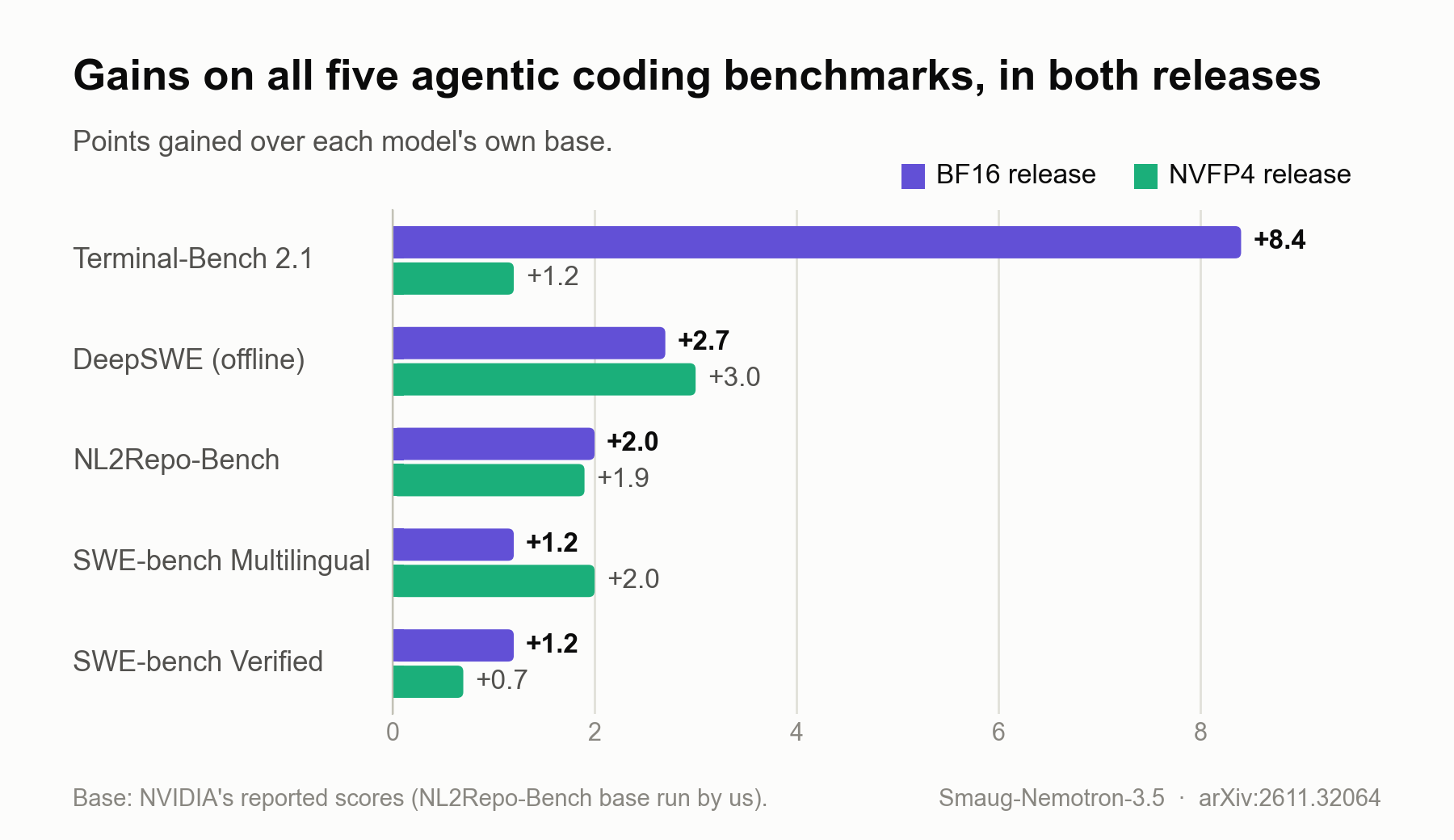
Both models beat their base on all five agentic coding benchmarks we track. The BF16 model gains 8.4 points on Terminal-Bench 2.1, and the 4-bit model gains up to 3 points:
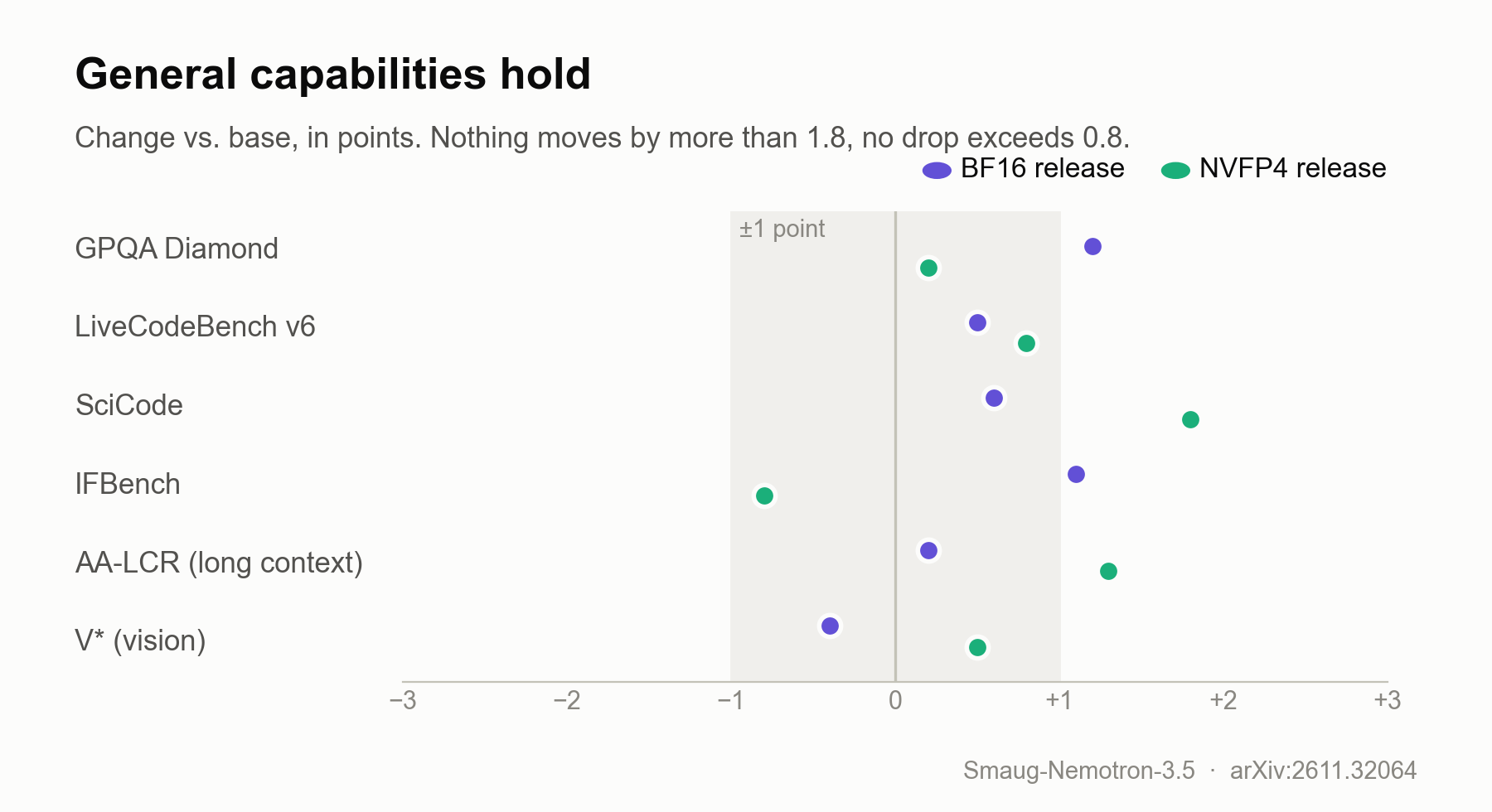
And nothing else broke. Across reasoning, code, instruction following, long context and vision, no score drops by more than 0.8 points:
The 4-bit model is the one most people will run, since all 120B parameters fit on a single H200. On the LiveBench 2.0 leaderboard it lifts the overall score from 46.5 to 50.3, led by Coding (+10.9) and Browser (+7.6), while Data Analysis (−0.6) and Research (−3.1) go down. Its gains are smaller than the BF16 model's for a simple reason: the 4-bit experts, which carry 43% of the change in the BF16 model, cannot move at this update size.
Is it really the merge?
To check, we trained a standard LoRA with everything else identical: same data, same order, same learning rate, same seed and the same action-only objective. Then we merged it the usual way.
At the weight level, the two are twins. Both keep 34% of their update through the merge, and both move the served weights by the same amount. On the benchmark, they are not close:
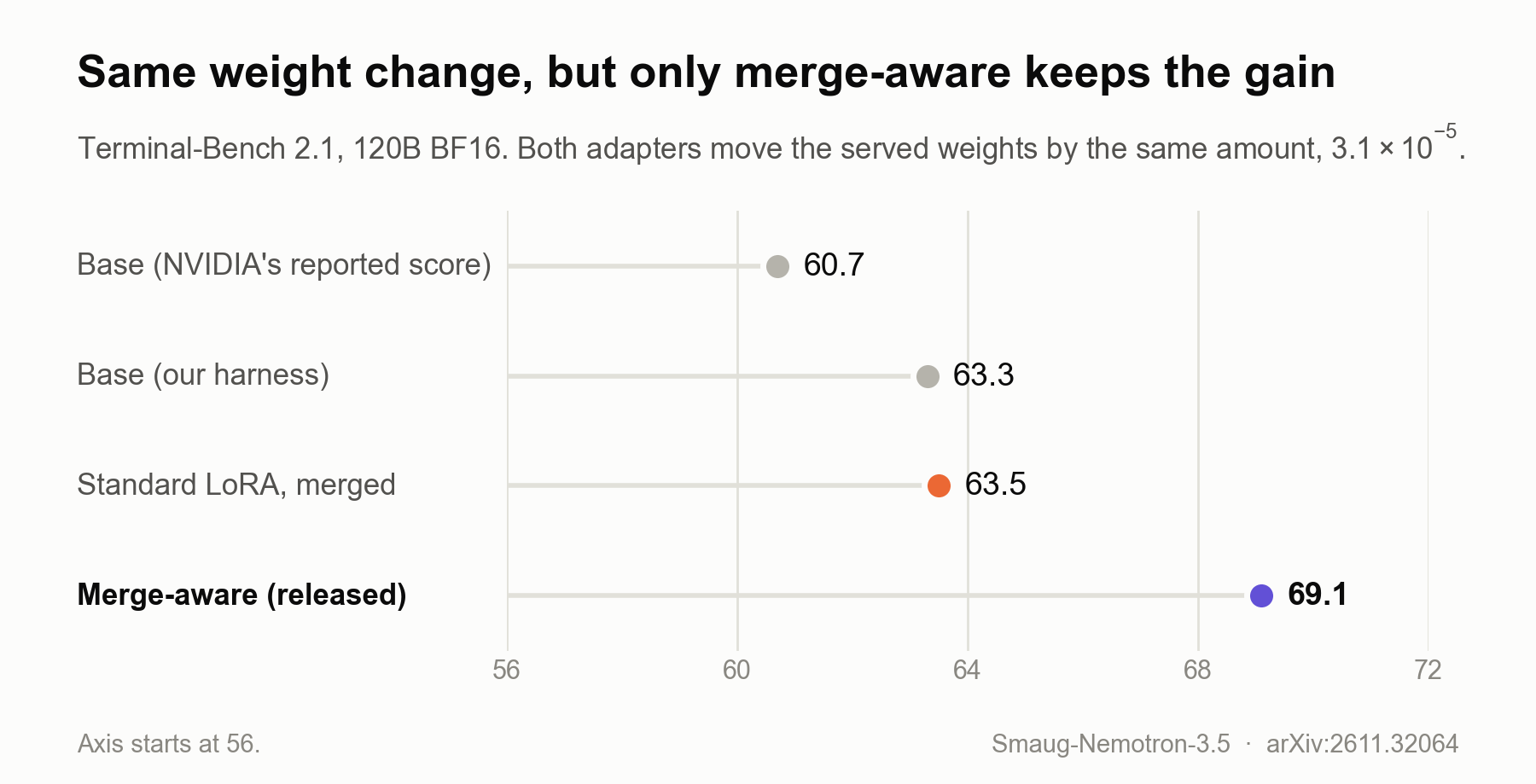
Run in our own harness, the base scores 63.3 rather than NVIDIA's reported 60.7. The standard LoRA scores 63.5, level with that base, while the merge-aware model reaches 69.1. On SWE-bench Verified, the standard LoRA even slips below the base. Same-sized change, very different result. The only difference is which model the loss was computed on.
Serving the adapter unmerged is no escape hatch either. In our tests on a smaller model of the same family, the engine applied it at only about half strength, without any warning.
Acts better, thinks the same
Scores tell you how many tasks passed. Trajectories tell you why. Per run of 89 Terminal-Bench tasks, our model passes 61.5 against the base's 56.3, and wrongly claims a task is complete 19.8 times instead of 23.7. When it says "done," it is right 75.5% of the time, up from 69.7%, while it reasons about as much per step:
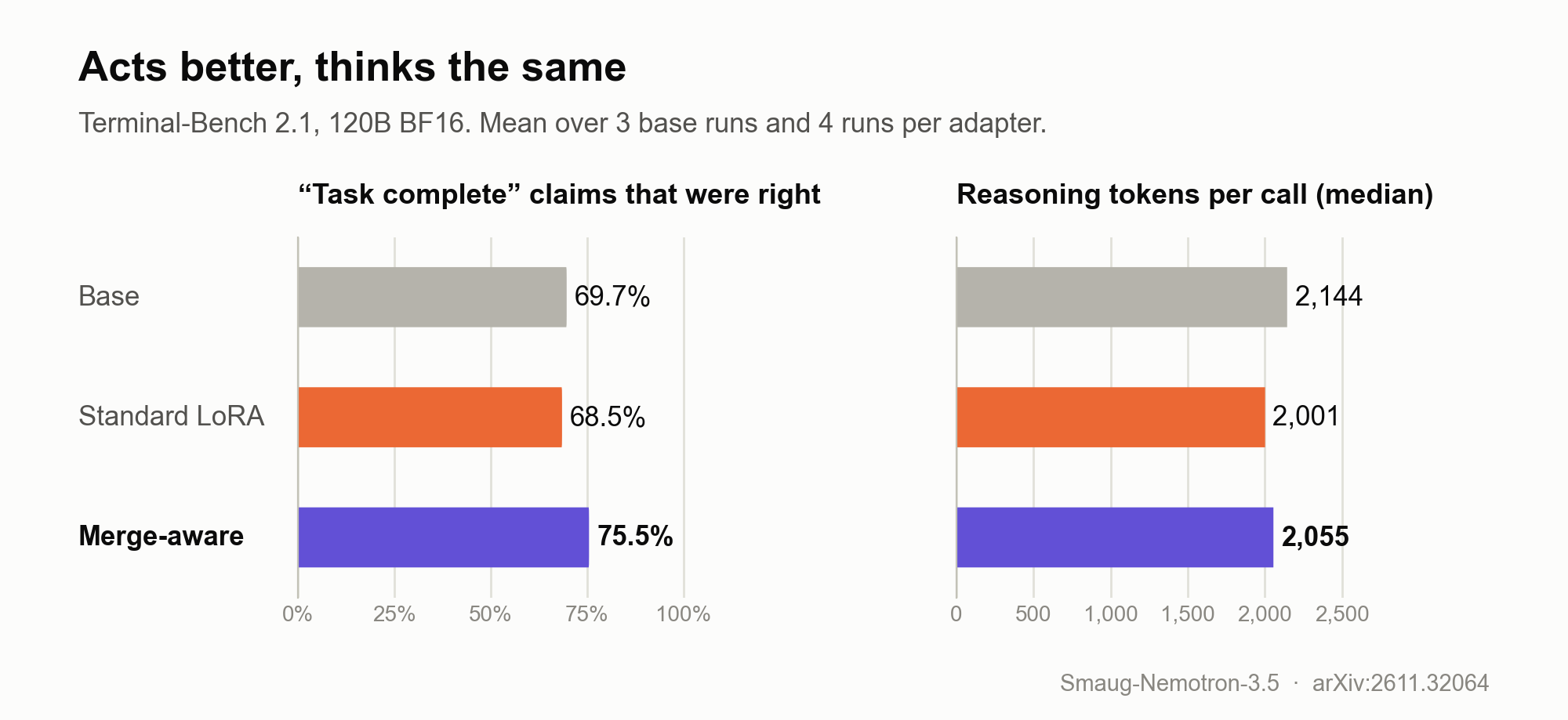
That is exactly the misstep we set out to fix: the model acts better and thinks the same. An LLM judge reading the full transcripts agrees. Our model repeats failed steps less often (37% of trajectories against 45%), and more of its runs show no failure mode at all (23% against 16%).
Try the models
Both models are drop-in replacements for NVIDIA's Nemotron-3.5-Super-VL checkpoints, with the same architecture, tokenizer and chat template. If your stack serves the base, it serves Smaug.
Smaug-Nemotron-3.5: BF16, 120B parameters with 12B active.
Smaug-Nemotron-3.5-NVFP4: 4-bit, about 75 GB, fits on one H200 or two H100s.
One tip for agentic coding: keep the model's past reasoning in the conversation, since the chat template drops it by default.
--default-chat-template-kwargs '{"truncate_history_thinking": false}'Full serving commands are on the model cards.
Train what you ship
For small, precise updates, merging isn't packaging. It is a lossy step that can silently erase exactly what you trained. The answer isn't a bigger update. It is training on the weights you will actually release, with the numerics of the engine that will serve them.
We think this reaches well beyond coding agents: anywhere a small change has to survive a coarse number format, from safety patches and unlearning to personalization and on-device models. The full story, with ablations and analysis, is in the paper: arXiv:2611.32064.