Most of the work people hand to AI today is long and open-ended, like fixing a bug in a big codebase or keeping a project on track for hours. Plenty of models that answer hard questions well still struggle with that kind of work, so we built a benchmark around it.
LiveBench started as an ICLR Spotlight paper and is regarded industry-wide as a go-to benchmark for evaluating models for real-world use. LiveBench 2.0 is the version on livebench.ai today, and this post walks through what it measures and where the models stand.
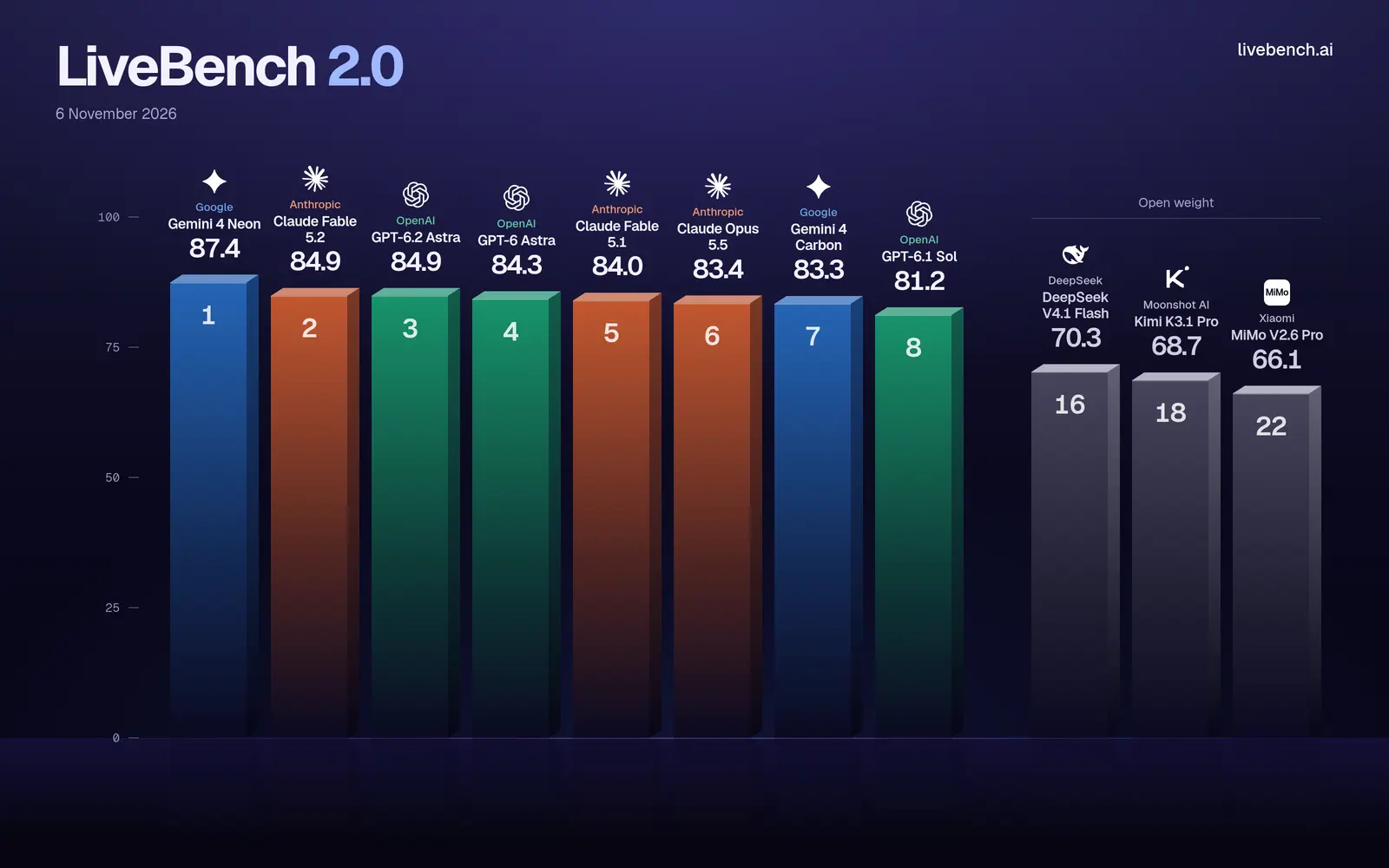
The November 6, 2026 board: the top 8 of 41 models, and the three best open-weight models at their real rank.
What LiveBench 2.0 measures
The board has seven suites. Five are agentic: the model works through a real end-to-end task in its own sandbox, with tools to plan, edit files, drive apps and run code, and is graded on what it leaves behind. The other two are short question sets.
- Long Agentic (18 tasks). Long engineering jobs where early decisions have to hold up through later turns. A single run takes hours and hundreds of tool calls. The model might take over a working business app, such as payroll, a council budget or a theatre box office, and keep it correct through rounds of changing requirements. Or it might build a compiler from a written specification, or run a system through simulated months of operations. Scripts grade the result against hidden reference data, test programs or simulated outcomes.
- Coding (24 tasks). Real bugs from merged pull requests in a large production codebase, frozen at a snapshot. The model gets the bug report and the repository. Hidden tests check the fix, and a fix that breaks existing behaviour scores 0.
- Browser (25 tasks). Multi-step jobs in working web apps (a shop, project boards, a scheduler, a ledger, a helpdesk and a wiki), done through a real browser that the model sees only by screenshot. One example is rebooking a doctor’s patients when she is off sick. The app’s data afterwards is checked against the expected outcome.
- Research (22 tasks). Open-ended briefs from a named person in a specific situation, often with files attached, that need a decision they can act on. One example is working out which flight disruptions in a claims log are owed compensation. Each report is graded against a task-specific rubric.
- Design (25 tasks). Word documents, PDFs and slide decks produced or reworked to a brief, such as cutting an eighteen-slide deck to six for the board. The rendered file is scored on visual and structural checks.
Data Analysis (150 questions) and Reasoning (202 questions) are not agentic: each question has one right answer, checked against ground truth. They cover table joins and reformatting, logic puzzles, spatial reasoning and theory of mind.
Every model gets the same tools and runs at its highest reasoning setting. The overall score is a weighted mean of the seven suites: Long Agentic counts double, Coding and Design count one and a half times, and the rest count once. The methodology page has the full details.
Where the models stand
On the November 6 board, 41 models are ranked. The top ten:
| Rank | Model | Lab | Overall |
|---|---|---|---|
| 1 | Gemini 4 Neon | 87.4 | |
| 2 | Claude Fable 5.2 | Anthropic | 84.9 |
| 3 | GPT-6.2 Astra | OpenAI | 84.9 |
| 4 | GPT-6 Astra | OpenAI | 84.3 |
| 5 | Claude Fable 5.1 | Anthropic | 84.0 |
| 6 | Claude Opus 5.5 | Anthropic | 83.4 |
| 7 | Gemini 4 Carbon | 83.3 | |
| 8 | GPT-6.1 Sol | OpenAI | 81.2 |
| 9 | GPT-6.2 Sol | OpenAI | 80.3 |
| 10 | GPT-6.1 Terra | OpenAI | 78.6 |
Long Agentic is where the field spreads out most. Only two models score above 80 there. Among the top ten, Long Agentic scores run from 55.3 to 82.9, a spread of almost 28 points.
The best open-weight models are DeepSeek V4.1 Flash (#16, 70.3), Kimi K3.1 Pro (#18, 68.7) and MiMo V2.6 Pro (#22, 66.1). All three are more than 40 points behind the leaders on Long Agentic.
The full board, with every column and every model, is at livebench.ai.