


Deep Learning (DL) has had immense success over the past few years in areas such as computer vision and speech recognition. Recently, DL techniques have also been used to enhance the performance of Recommender Systems (RS). Most major websites and services are using RS enhanced with DL in a constant attempt to improve the overall user experience. Netflix recommends which shows to watch next, YouTube throws a video your way, Google Play suggests other apps you might enjoy, and even text-based services like Yahoo News are using neural networks to provide recommendations for millions of users. Let’s dissect the underlying technologies and see why Deep Learning is the right choice for Recommender Systems.
Why do companies bother about Recommender Systems in the first place?
We live in a highly digital era when heaps of data and content are being generated daily. Considering how many item options there are to choose from, users can easily suffer from choice paralysis. This is where the RS steps in, helping to narrow down the stream of products based on individual user preferences.
Ever finished watching a good show on Netflix only to immediately discover something great in the recommended section? That’s a good RS doing its work.

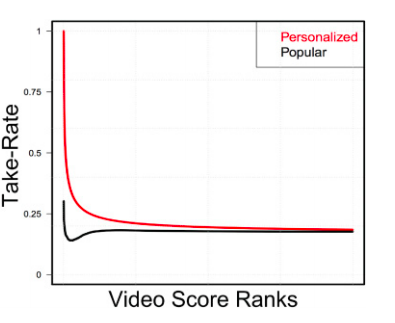
According to stats from Netflix itself, users are 2–4 times more likely to check out the content at the top of their recommended list if it’s personalized, as opposed to seeing a general “popular” list which is the same for everyone. Overall, 2 of every 3 hours streamed on Netflix are discovered through the homepage from the recommended list. The RS in total influences choice for about 80% of hours streamed at Netflix, whereas the remaining 20% comes from the search function.
YouTube is another prime example of successful RS usage — out of the millions of videos available, the system manages to present users content tailored to their preferences. Their system does this in two steps:
- Based on user history, the RS performs candidate generation, funneling down from millions of videos to hundreds.
- Narrowing down even further using video features and other sources, the system ranks the candidates and outputs around a dozen videos from the top of the list.


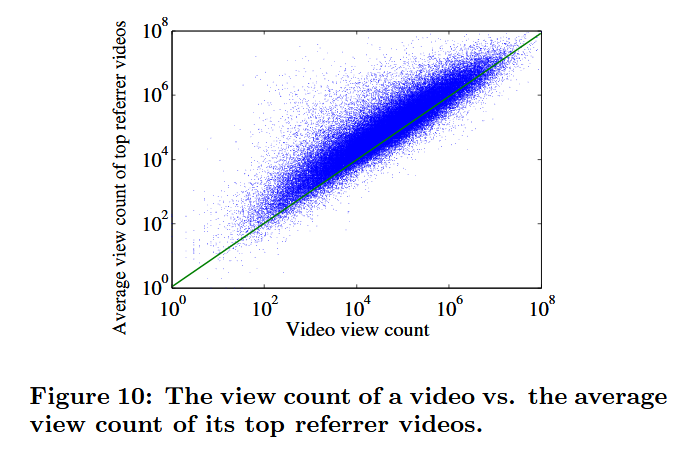
As a result, recommendations account for about 60% of all video clicks from the home page. The related videos section also causes high correlations between the views of a video and the views of its top referrer videos. The correlation coefficient is equal to 0.60, indicating just how well the RS chooses relevant videos.

How can Deep Learning improve Recommender Systems?
At their core, RS are based on techniques such as Collaborative filtering, Content-based filtering, or a mix of both. However, they are not without their flaws. The sheer amount of content and users makes it rather difficult to build precise predictions, especially when users have a short interaction history, or when certain items aren’t that popular. DL techniques bring several strengths to the table:
- Nonlinear Transformation. Conventional methods such as matrix factorization are linear models. By using deep neural networks, RS can model non-linear effects and capture complex user-item interaction patterns.
- Representation Learning. In real-world applications, there is usually a lot of descriptive information available about items and users, which neural networks can use to better understand them. As a result, less effort is spent on feature design, and the system can learn from substantive information such as text and images, instead of being based solely on clicks, reviews, and purchases.
- Sequence Modeling. Several sequential modeling tasks such as machine translation and speech recognition have seen success by implementing DL. This finds important applications in understanding the temporal dynamics of user behavior and item evolution.
- Flexibility. There is a wide variety of DL tools available (Tensorflow, Keras, Caffe, etc.), most of which have an active community, professional support, and are developed in a modular way. The modularization increases development efficiency, making it easy to build hybrid models.
Based on how they are built, contemporary DL RS are categorized in two ways: 1) Recommendation with neural building blocks (using a single DL model); 2) Recommendation with Deep Hybrid Models (utilizing several DL techniques simultaneously).

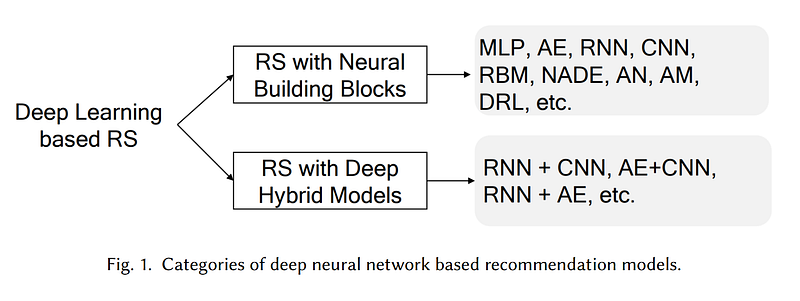
Of the various building blocks, two stand out based on their importance and frequency of usage — Convolutional Neural Networks and Recurrent Neural Networks.
CNNs
Convolutional Neural Networks (CNNs) are a form of network-based on animal visual perception. Starting from the lower layers, which learn basic features such as edges, the network gradually represents the object in features of higher-order, like eyes on a face or cars on a street. The visual features of an item are of high importance in fashion, retail, and entertainment, so recognizing these features and grouping items is a good way to help users find items similar to what they like.
When brand new items are introduced into the system, recommenders run into the so-called “cold-start problem”, when very limited data is available about the content. CNNs help alleviate this problem by grouping new items with existing ones based on their features. We should note that this is not used just in visual representation. Spotify uses CNNs to extract audio features from songs and introduce brand new tracks and artists into user playlists.
RNNs
Recurrent Neural Networks (RNNs) are best suited for sequential data processing. Unlike feedforward neural networks, RNNs can use their internal memory to process arbitrary sequences of inputs. This is perfect for situations when users don’t log into systems and the recommender system has to make predictions based on very sparse data stored in cookies. Learning from user clicks, the network gives predictions on the user’s short-term decisions, i.e. their next click. This is a highly underappreciated application of neural networks.
Naturally, the same benefits are even more visible with long-term decisions. If a user does log into a website, the RNN now has access to a whole history of decisions, which makes it better at predicting what the user will enjoy in the future.
Recommender AI offered by RealityEngines
By choosing RealityEngines you’ll have all your recommender needs covered. With state-of-the-art, multi-objective, real-time recommendation models you will surely increase user engagement and revenue. We offer:
- Personalized Recommendations. Our technologies work even when you have little historical data and have to deal with a fast-changing catalog or multiple new users.
- Related Items. Create a related item section for users based on their unique experiences.
- Personalized Re-Ranking of Lists. This includes search results, item lists, and others.
If you want to learn more about the process or contact our team for a consultation, be sure to check out the Recommender AI section on our website.


- Improving Open-Source LLMs – Datasets, Merging and Stacking - January 11, 2024
- Open Source LLMs, Fine-Tunes and RAG Based Vector Store APIs - October 19, 2023
- Closing the Gap to Closed Source LLMs – 70B Giraffe 32k - September 25, 2023